

An Alternative Approach
Introduction
A client once told me: I know there is nothing to fear, yet every time I walk into a shopping centre my heart races, my breathing becomes shallow, and all I want to do is escape. Rationally, she knew she was safe. Emotionally, her brain was convinced she was in danger.
Many people enter therapy hoping for clarity, relief, or transformation. Yet too often, the process feels like circling the same struggles without resolution. You talk, reflect, and analyse – but the pain remains. Some form of traditional approaches like Person-Centred Therapy and Cognitive Behavioural Therapy emphasise logic and insight, assuming that if you think differently, you will feel differently. But what happens when your emotions refuse to obey reason? What if the real source of the struggle lies deeper than thought — in the instinctive systems of the brain where fear, trauma, and survival reside?
The problem with psychotherapy
How often do you face challenges that simply do not make sense? How often do you feel too embarrassed to share them, worried they might sound ridiculous? And endlessly do these challenges persist, no matter how hard you try to overcome them?
How often have you attended therapy for months-or even years -only to feel it hasn’t helped? How often do you find yourself going to session after session, talking about your struggles without finding solutions? Too often, therapy becomes a cycle of repeating your feelings in different words, accompanied by the familiar, empathetic question: How does that make you feel?
This style of reflective listening is characteristic of Carl Rogers’ Person-Centred Therapy (PCT), still considered one of the most widely accepted models of psychotherapy.
There’s a well-known joke about Rogers: A client sees Rogers in his office in a tower building in New York. and tells him he feels depressed. Rogers reflects: You feel depressed. The client escalates: I am so depressed that I feel like I could kill myself. Rogers responds: You feel so down you could even take your own life. The client continues: I feel like jumping out that open window. Rogers replies: You feel so desperate you want to jump out that window. The client then leaps, shouting: I am juuuumpiiingg!!! Rogers then looks up and says: Plump!
The story humorously illustrates the technique of reflective listening. Whether effective or not remains an open question.
Another dominant school of psychotherapy is Cognitive Behavioural Therapy (CBT). CBT proposes that distorted or unhelpful patterns of thinking contribute significantly to emotional distress, and that rational thought can resolve these challenges. Yet even when you recognize your fears as irrational, they often persist and escalate.
Most forms of traditional psychotherapy helps you talk about your challenges and reframe them logically. But reframing does not necessarily make you feel better. Talking about feelings may provide perspective, but it rarely changes the underlying problem – it only offers more options for potential solutions.
To understand it, we first need to take note of the structure of your brain before we go any further.
The brain and psychotherapy
The Brain’s Functional Systems
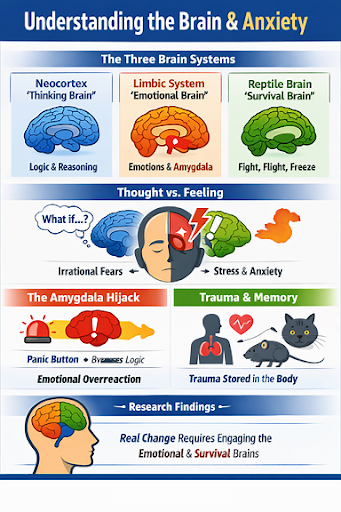
For simplicity, we will use the familiar three functional systems model. Although modern neuroscience recognises that the brain functions as highly integrated networks rather than three separate brains, this model remains a useful way of understanding how thinking, emotion, and survival responses interact.
- Neocortex (Thinking Brain)
- Responsible for logic, reasoning, and perception.
- The analytical centre that processes language and rational thought.
- Limbic System (Emotional Brain)
- The amygdala functions like an alarm system.
- The amygdala scans incoming information for danger or pleasure.
- If danger is detected, it activates the fight, flight, or freeze response in the reptile brain.
- Reptile Brain (Primitive Brain)
- Instinctively prepares you to fight, flee, or freeze when danger is perceived.
- Includes the brainstem and other primitive structures involved in survival.
- Governs survival functions such as heart rate, respiration, and blood pressure.
Schematically, the three parts of your brain look like this

Traditional Psychotherapy Compared to more Modern Psychotherapy
Traditional psychotherapy starts from the idea that when you gain more insight into a challenge or yourself, you’ll feel differently. In other words, if you use your neocortex and think differently, your emotions in your limbic system, amygdala, and hippocampus will change, and it will also cause your reactions in your brainstem and cerebellum to change.
Psychotherapy may follow one or more of three avenues:
- Top-down, from the neocortex (1) to the lower two systems (2 and 3), by talking and allowing ourselves to know and understand what is going on with us, while processing the memories of the trauma.
- By taking medicines that shut down inappropriate alarm reactions, and
- Bottom-up (from 3 up to 1) by allowing the body to have experiences that deeply and viscerally contradict the helplessness, rage, and collapse that result from trauma.
Modern, alternative therapy prefers to follow a process from the bottom up. Hypnosis, BWRT, NLP and EcCT believe that when you address the feelings, helplessness, rage and trauma first, your emotions will then change (2). And when your emotions change, your thinking (1) will then change.
When Thoughts and Feelings Conflict
Clients often describe their challenges as irrational, yet they feel intensely real. Unlike the neocortex, the limbic and reptile brains communicate through sensations, emotions, and survival instincts – not logic.
The thinking brain produces irrational fears – what I call the what if disease. Anxiety arises from catastrophic thoughts about what might happen, even if those scenarios are unlikely. These thoughts send danger signals to the limbic and reptile brains, which interpret them as literal threats. Adrenaline and cortisol flood the body, triggering fight, flight, or freeze.
The result: constant stress, hypervigilance, and the feeling of needing to defend yourself against dangers that do not exist.
The Role of the Amygdala
The Amygdala is the:
- Alarm system of the brain.
- Located in the limbic system, at the end of the hippocampus.
- Responsible for emotional memory and responses, especially fear.
- Triggers fight (anger), flight (fear), or freeze (anxiety).
Prolonged stress and anxiety can lead to depression due to the constant release of cortisol and adrenaline.
The amygdala – the brain’s panic button can hijack the neocortex, overwhelming rational thought. This leads to emotional overreactions that feel instinctive rather than logical.
Later, when the neocortex regains control, you may feel ashamed or regretful about your reaction.
Traumatic memories are often encoded with powerful bodily sensations and emotions, making them feel very different from ordinary autobiographical memories. The body retains what the mind forgets, which explains why emotional triggers can feel overwhelming even when logic says otherwise.
Please refer to the illustration beneath:

Quick facts:
- the alarm system of the brain;
- location: part of limbic system, or emotional brain; at the end of the hippocampus (memory);
- function: responsible for the response and memory of emotions, especially fear, and results in the fight, flight or freeze response.
What Is Amygdala Hijacking?
Amygdala hijacking is an immediate, overwhelming emotional response, followed by the later realisation that the reaction was disproportionately intense for the situation. The term amygdala hijacking was coined by Daniel Goleman, based on the pioneering work of neuroscientist Joseph LeDoux.
LeDoux demonstrated that some emotional information can travel along a rapid neural pathway from the thalamus to the amygdala, bypassing the neocortex. This allows the brain to respond to potential danger before conscious thought has fully processed the situation.
The thalamus acts as a relay station, directing incoming sensory information to different parts of the brain. Under normal circumstances, information is sent to the neocortex, where it is analysed logically and rationally before an appropriate response is generated. However, when the brain perceives an immediate threat, a faster pathway allows information to travel directly from the thalamus to the amygdala. This low road enables an almost instantaneous emotional response, which can occur before conscious reasoning has had time to evaluate the situation.
During an amygdala hijacking, the amygdala temporarily dominates the brain’s response, reducing the influence of the prefrontal cortex – the part of the brain responsible for reasoning, judgement, planning, and impulse control. As a result, a person may react emotionally before thinking logically, only recognising later that the response was excessive or inappropriate.
Interesting Research Findings
In experiments, rats with their amygdala removed showed profound reductions in fear responses – even of cats. Some were observed crawling over cats without hesitation.
This demonstrates the importance of anxiety for survival. Without it, we would take reckless risks. With too much, we would be paralyzed. The right balance enables us to navigate life safely while still taking necessary risks.

Closing Thought
Many traditional psychotherapies often focuses on the thinking brain. Yet many challenges originate in the emotional and reptile systems. Effective change requires approaches that engage these deeper, instinctive parts of the brain – where survival, fear, and emotional memory reside.
Beyond Thinking: Toward Real Change
Psychotherapy has long focused on the thinking brain, but lasting change requires more than insight. Anxiety, trauma, and irrational fears are rooted in the emotional and primitive systems that drive survival. To heal, therapy must reach beyond logic – engaging the limbic and reptile brains where instinct and memory live. Only by addressing these deeper layers can we move from endless reflection to genuine transformation. The future of therapy lies not in asking How does that make you feel? but in helping the brain itself feel safe enough to change.